Circular Economy and Waste Management
Circular Economy and Waste Management at Türk Telekom
At Türk Telekom, in line with our sustainable environment policy, we recognise waste management as a critical responsibility in terms of efficient use of resources, supporting the circular economy, and minimising environmental impact. In this context, we manage waste generated from our infrastructure investments and operational processes within a sustainable framework. We are implementing various projects to improve recycling processes, minimise waste generation, and use existing resources as efficiently as possible.
We prioritise minimising waste generation, increasing recycling rates and supporting reuse opportunities. To this end, we segregate different types of waste, such as plastic, glass, papercardboard, metal, toner, cartridges, electronic materials, cables, generator fuel and batteries, at source and direct them to licensed recycling and disposal facilities. As Türk Telekom, we prioritise recycling e-waste using the correct methods and support circular economy models to ensure the efficient use of resources. We manage the entire process from the production to the disposal of all types of waste generated by our activities in a manner that does not harm human health or the environment, in full compliance with national and international regulations, applicable legislation and environmental standards. In this regard, we adopt an approach focused on reducing waste generation and increasing recovery in waste management. In line with circular economy principles, we aim to reduce the amount of waste sent to landfill sites by preventing waste at source and promoting reuse and recycling practices. With this approach, we aim to increase resource efficiency and reduce environmental impacts.
We consider reducing the environmental impact of electronic equipment that has reached the end of its service life or lost its functionality to be an important part of our responsible product management approach. In line with this, we take back the devices and equipment we use in the services we offer our customers as part of subscription process changes and device renewal applications, and monitor the relevant processes through our corporate operating systems.
We recycle electronic equipment that has reached the end of its useful life through licensed recycling companies with whom we have agreements, ensuring that the recycling processes comply with current environmental regulations. With this approach, we contribute to reducing electronic waste generation while also supporting the more efficient use of natural resources. During the 2025 reporting period, the total amount of electronic waste delivered to licensed recycling companies under our take-back programmes amounted to 1.2 tonnes. Of the total amount of electronic waste, 0.8 tonnes come from waste generated at our facilities, whilst 0.4 tonnes consist of waste collected on our behalf by TÜBİSAD.
We conduct our waste management activities in line with international standards through the TS EN ISO 14001:2015 Environmental Management System; we ensure that all our operational sites are certified with these systems. To ensure the traceability of waste, we declare our processes through the Integrated Environmental Information System (EÇBS) and the Zero Waste Information System. We also track waste movements digitally using the Mobile Hazardous Waste Transport (MoTAT) system. This enables us to operate a transparent, traceable and fully compliant waste management system.
In waste management, we develop systems aimed at preventing waste generation and implementing source separation practices. By continuously updating our technical and administrative standards, we focus on creating both environmental and economic benefits.
In 2025, we made infrastructure investments totalling 3.8 million TL at three different locations to ensure the storage and management of hazardous waste in a manner that complies with regulations, is safe, and minimises environmental risks. Within this scope, we completed the construction of hazardous waste storage facilities at our Van and Hakkari Demand Centres; at our Kırklareli Demand Centre, we implemented maintenance and improvement activities for the existing hazardous waste storage facility. Through these investments, we aimed to increase the effectiveness of our hazardous waste management processes, reduce environmental risks, and fully comply with our legal obligations.
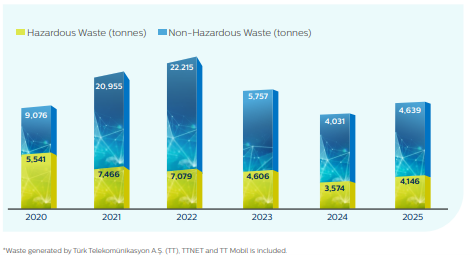
As of 2025, the total amount of waste generated within the scope of our activities was 8,785 tonnes. Of this amount, 4,146 tonnes consisted of hazardous waste and 4,639 tonnes consisted of non-hazardous waste.
We collaborate with licensed companies to manage our waste disposal and recycling processes in a sustainable, environmentally friendly, and efficient manner. In the licensed company selection process, we carefully evaluate the companies’ licence adequacy for different waste types, their compliance with environmental legislation, their experience, and the environmental standards they apply.
As the Türk Telekom Group, we diverted a total of 9,429 tonnes of waste for recycling through licensed waste management companies in 2025. In this context, considering the share of recovered waste in the total amount of waste generated, our Waste Recovery Rate was 99%.
We operate a comprehensive monitoring and tracking mechanism through our specialist units to ensure that our waste management practices are correctly implemented in the field. While the activities of contracted companies are regularly monitored, our environmental engineers also play an active role in the processes, ensuring full compliance with national and international regulations.
All waste generated from our activities is classified and managed separately according to type. Waste that can be recycled is sent to licensed recycling facilities, while waste that cannot be recycled is directed to disposal facilities in a manner that minimises environmental impact. All waste generated at our facilities and field operations is collected by authorised companies and managed in accordance with the regulations.
Through our partnerships with authorised organisations, we manage our waste using safe and environmentally conscious methods. In this context, waste batteries are managed safely through AKÜDER, waste oils through PETDER, and waste batteries through TAP.
Our Zero Waste Project
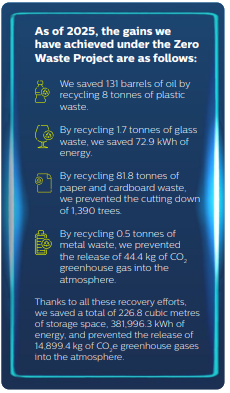
As part of our Zero Waste Project, which we have been implementing in all our offices since 2019, we are working to make our employees’ daily consumption habits environmentally conscious. Within the scope of the project, we manage the entire process from waste generation to disposal in a manner that does not harm human health or the environment, in accordance with technical and administrative standards. All recovery, temporary storage and disposal processes are handled with an environmentally friendly approach.
We aim to increase our environmentally conscious practices by continuing our pioneering role in waste management for a sustainable future. The protection of natural resources, the effective management of recycling processes, and the reduction of our environmental impact are among our fundamental principles, along with our goal of making an economic contribution.
Recycling of Electronic Waste
The increasing use of electronic equipment, driven by digitalisation, makes the environmentally conscious management of electronic waste essential. While reducing the environmental impact of electronic waste, we channel the revenue generated from this process into projects that provide social benefits.
We are planning to launch a nationwide Electronic Waste Mobilisation Project in the coming period. The project’s objectives include organising awareness campaigns to encourage our customers to participate in electronic waste collection processes, increasing the number of electronic waste collection points, and raising employee awareness. In this way, we aim to encourage active participation in the recycling process.
Economic and Environmental Gains with the Circular Economy
An important part of our waste management practices is the circular economy approach, which involves returning recyclable materials to the economy. In this context, we generated 101.3 million TL (excluding VAT) in revenue from the sale of a total of 3,542 tonnes of scrap (14 different types of scrap) in 2025. Additionally, we generated an additional 9.9 million TL in revenue by reintroducing electronic equipment into the economy as second-hand goods.
In the coming periods, we will continue to advance our waste management processes and build a strong circular economy model from both an environmental and financial perspective. We will continue to be a pioneer in sustainability with our practices that conserve natural resources, save energy and reduce carbon emissions.
Sustainable Packaging
At Türk Telekom, we implement practices that enhance resource efficiency, support the use of recycled materials, and reduce packaging-related waste in order to minimize the environmental impacts of our products and services. Within this scope, we encourage the use of recycled materials in the production and packaging of end-user devices and support the use of recycled plastic and cardboard through our technical requirements. We use 100% recycled plastic in our SIM cards, while expanding the use of packaging materials made from recycled cardboard across end-user devices.
We also reduce printed materials included in product packaging by digitalizing user manuals and providing access to digital content via QR codes. Through these practices, we aim to reduce paper and plastic consumption, improve resource efficiency, and minimize the environmental impacts of our products throughout their life cycle.