Water Management
Water and Wastewater Management at Türk Telekom
We act with a sense of responsibility regarding the management of water, one of the most vital resources. We take a holistic approach that encompasses water consumption, conservation, efficiency, and recovery processes. We regularly monitor water usage data at all locations where we provide services and continue our conservation efforts in specific areas of operation. We have been awarded an A-rating in the CDP Water Security programme as a result of our efforts in this regard. We aim to expand the scope of these efforts in the coming periods.
We implement a structured water management approach across our operations to ensure the responsible and efficient use of water resources. We conduct our water management activities in line with a comprehensive plan that encompasses monitoring water consumption, optimising usage, reducing losses and leaks, and increasing water efficiency in operational processes. In this context, we regularly monitor water consumption at our data centres and office locations. In our operations located in water-stressed regions, we prioritise preventive measures to reduce water usage and evaluate alternative efficiency solutions.
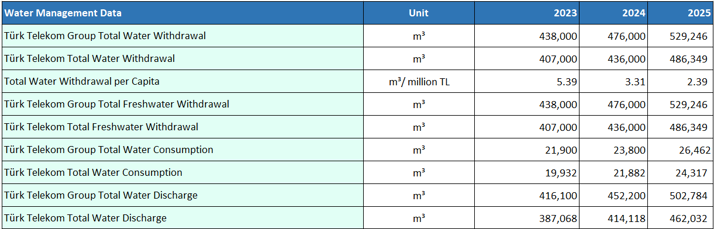
Water quality and water usage in our buildings are regularly monitored in accordance with relevant legislation, and no instances of noncompliance with relevant legislation were identified during the reporting period. The Türk Telekom Group’s total water consumption for 2025 was 529 thousand m3 We source the water used in our operations from freshwater resources, with the majority comprising potable and utility water supplied through municipal networks. We do not directly abstract water from seawater, saltwater or brackish sources for our operations. Accordingly, all water withdrawal is classified as freshwater withdrawal, and the relevant data is monitored and reported on this basis.
Water Stress and Management
The limited nature of water resources, coupled with population growth and climate change, is becoming an increasingly critical issue. According to the World Resources Institute (WRI), global water demand is expected to increase by 30% by 2050, and Türkiye is among the countries experiencing high water stress.
As part of our environmental sustainability efforts, we continuously monitor our water usage, implement efficiency-focused improvements in our infrastructure, and fulfil our responsibilities towards protecting water resources. We aim to ensure the effective and sustainable management of water throughout our entire value chain and to collaborate with our stakeholders in this area.
Türkiye’s location in a region with a high risk of water stress makes the effective and efficient management of water resources even more critical. In this regard, as Türk Telekom, we consider increasing water efficiency in locations at risk of water stress to be a key priority, given the responsibility that comes with being an organisation operating in all 81 provinces. Within this scope, we are conducting studies to identify facilities experiencing water stress and to monitor water usage in these locations. The water used in our facilities is sourced from local resources and supplied through municipal networks in the locations where we operate. We assess water stress levels at the locations of our facilities using the WRI Aqueduct Water Risk Atlas. Based on the assessment, 52.81% of the locations from which we withdraw water are located in water-stressed areas. In 2025, 75.94% (401,920 m³) of our total water withdrawal was from these areas. We regularly monitor water use in water-stressed areas and expect our water withdrawal levels to remain broadly stable in the coming period.
Efficient Water Use and Recycling Efforts
Through our water efficiency initiatives, we aim to keep our water consumption under control and increase our water savings. A significant portion of our water consumption stems from daily usage by our employees. Therefore, to minimise consumption, we are promoting technologies that promote efficient water use, such as battery-saving devices and sensor-activated taps, while also organising programmes to raise water consumption awareness among our employees. In 2025, as part of the return to office process, we made investments to increase water efficiency through improvement works carried out in our buildings. In this regard, we installed 100 sensor-activated taps and renovated 35 sensor-activated urinals in our facilities. With this investment, amounting to approximately 2.6 million TL, we have contributed to reducing our water consumption and using resources more efficiently through the use of new-generation technological products. We are focusing on using existing water resources in the most efficient way possible while reducing water usage with modern infrastructure solutions that save water.
As part of our efforts to increase water efficiency in our data centres by 2025, we have focused on expanding the use of misting systems in condenser units. In line with this application, which is more efficient than traditional cooling methods, we integrated new-generation solutions that optimise water usage into condensers that previously did not have misting systems at our Ankara Ümitköy and Esenyurt Data Centres. The water savings achieved thanks to the misting system put into operation at our Ümitköy Data Centre correspond to approximately 20% the facility’s annual water consumption.
Rainwater Harvesting and Alternative Water Management Solutions
In line with our vision of protecting water resources, we are implementing projects aimed at increasing the use of alternative water sources. In this context, we have implemented a “Rainwater Harvesting” project at our logistics centre in Petekkent, Istanbul. At our logistics centre, which covers an area of 7,150 m2 , we harvest rainwater and store it in a 41,500-litre underground water tank. We reuse collected water for purposes such as garden irrigation, reservoir filling and vehicle washing, thereby contributing to reduced freshwater consumption.
We set annual water saving targets to carefully manage water consumption and operate our facilities accordingly. The main reasons for the increase in water consumption in 2025 include the rise in office-based working practices and the inclusion of new locations opened during the year in consumption.
Wastewater Management and Environmental Standards
The discharge of wastewater generated from facility operations in Türk Telekom buildings is carried out in accordance with the standards set by the General Directorate of State Hydraulic Works (DSİ) and the Istanbul Water and Sewerage Administration (İSKİ). We manage wastewater discharges at our facilities in accordance with the minimum standards set out in, which we implement at central locations, and focus on minimising the environmental impact of wastewater generated by building usage.
We did not experience any non-compliance incidents in 2025 regarding water quality or water withdrawal permits, standards and regulations. In this context, no administrative sanctions, fines or coercive decisions were imposed on us due to non-compliance with water withdrawal permits, wastewater discharge permits or other water and wastewater regulations.
Although our environmental impact is limited due to the nature of the sector in which we operate, we are mindful of the indirect environmental impacts arising from our operational processes and supply chain. We are working to minimise these impacts by ensuring the recycling of wastewater and optimising disposal processes. We aim to establish a sustainable water management model by supporting our water management processes with environmentally friendly practices, recycling solutions, and efficiency-focused investments.
We conduct our environmental activities in compliance with national legislation and international frameworks. In order to minimise the environmental impact of the wastewater generated as a result of our operations, we fully comply with national and local discharge regulations set by the State Hydraulic Works (DSİ) and local authorities (including İSKİ). As Türk Telekom, we discharge all water from our facilities into the municipal sewage system. We assume that 5% of the total water drawn across our facilities evaporates due to operational processes, while the remaining 95% is discharged as wastewater into the municipal sewage system; in this context, we regularly monitor and report wastewater volumes. As of 2025, we have discharged a total of 503 thousand m3 of wastewater into the municipal sewage system.